Describe your current work.
I joined Fujifilm as a mid-career hire in August 2023 and am currently part of the Graphic Design Group. I’ve been involved in designing health supplement packaging, instax™ film, and labels and logos for medical products.
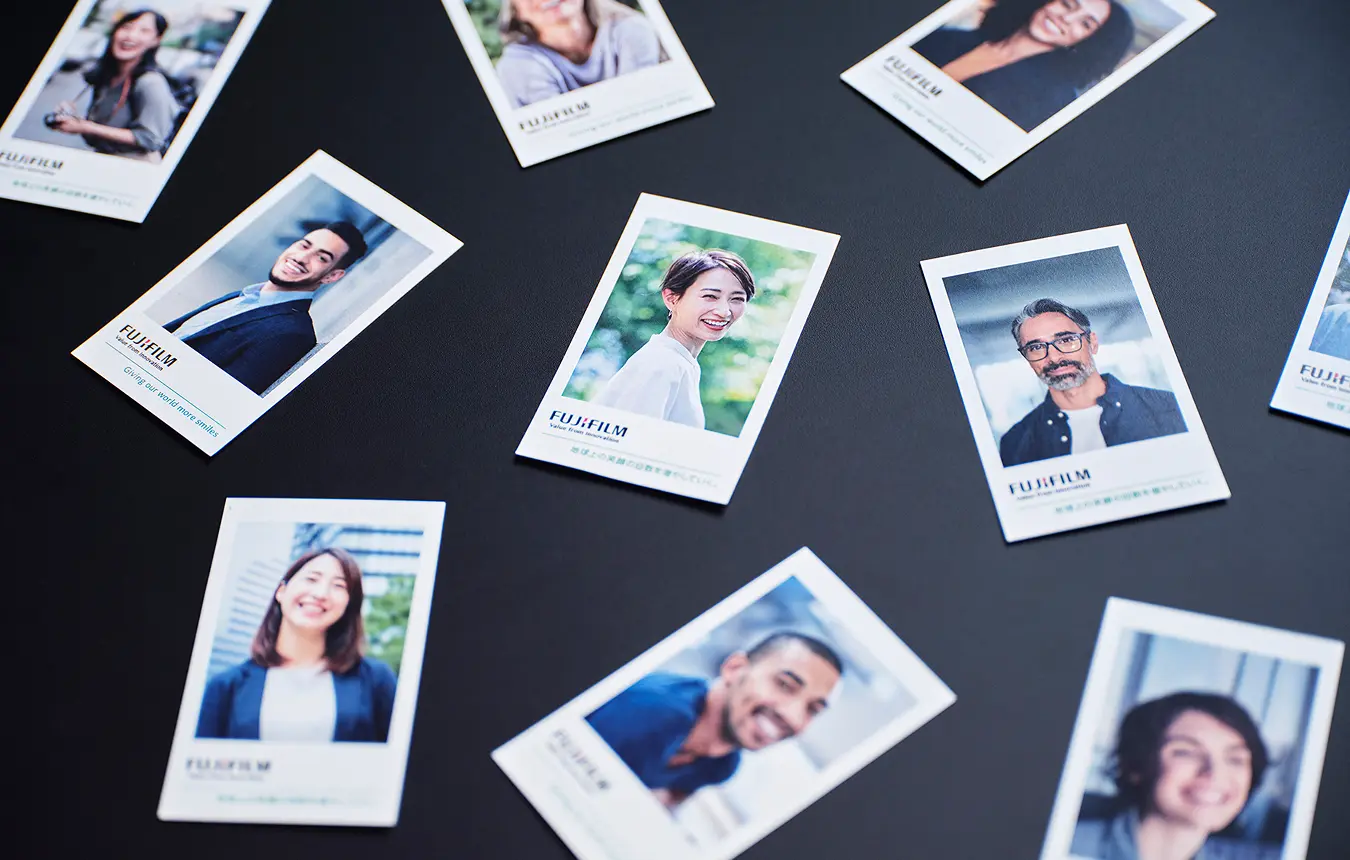
One job assigned to me immediately after joining Fujifilm was a redesign of the business cards used by everyone across the Fujifilm Group. I had some previous experience designing business cards, but this new design was part of our activities to communicate Fujifilm’s new Purpose, so the unified format was to be used by all 70,000 group employees. In the design, I focused on fully communicating Fujifilm’s message as a company and our brand value.
What can you tell us about the specifics of the design?
I had several missions with this design. The business card itself had to be a tool that embodies the Purpose, employees had to feel a connection to the Purpose, and employees had to become advocates for the Purpose through their business cards. On top of all that, I also aimed to create a design that inspires smiles, which are a universal language beyond words.
Fujifilm engages in business all over the world, so fully communicating the significance of the Purpose to people with diverse backgrounds was one challenge to overcome. Featuring smiles in the design addressed this by enabling both verbal and non-verbal communication. The photo format also matches instax™ film. I hoped that this design embodying the spirit of Fujifilm would inspire spontaneous smiles when employees exchange business cards.
What challenges did you encounter when developing this design?
Fujifilm has employees with diverse backgrounds from various countries and cultures, and ensuring that everyone could fully communicate our Purpose through the business cards was extremely challenging.
Another difficulty was the fact that the length of group company and department names vary significantly, and that some people have multiple job titles. The process was more complex than simply organizing information. When I sat down and thought about 70,000 employees around the world all using business cards with this design, I became keenly aware of the scale of the challenge.
We already had unified company guidelines regarding fonts, so keeping those consistent was less of an issue. However, we received requests such as people from sales departments wanting to include the logo of the brands that they handle. We left a reasonable amount of blank space to accommodate a logo as needed, but the cards also had to look good without a logo in that space, which was a difficult balance to strike. Business cards should inspire trust, and I also paid careful attention to the spacing between lines and characters to achieve that.
To me, Fujifilm has a sincere, earnest image, and I worked to ensure those elements came across in the design. In that respect, I’m happy with how the final result came out.
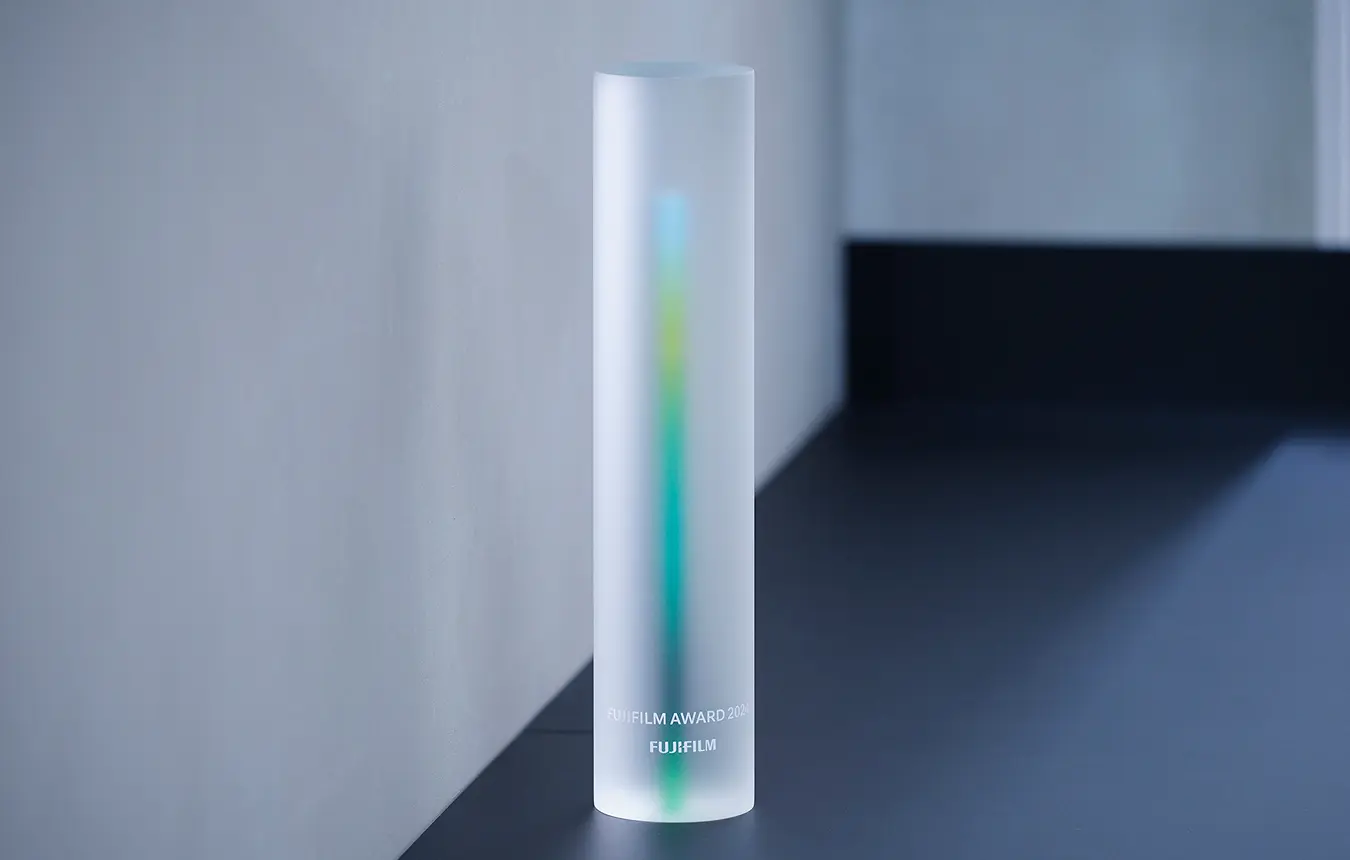
As part of Fujifilm’s corporate design, you also designed the trophy and ceremony-related items for the groupwide FUJIFILM AWARDS.
That’s right. The FUJIFILM AWARDS is an award program covering the entire Fujifilm Group that recognizes success in innovative initiatives. With the change to the new Purpose that we just discussed, the company also decided to redesign items such as the trophy and certificates, which had been in use for a few years. I was responsible for that redesign project.
In terms of the design, I was determined to convey at a glance prestige and a sense of design befitting Fujifilm, given its status as an award representing the Fujifilm Group. I also think having a form that colleagues immediately recognize when someone has a trophy on display in the office boosts the motivation of people who receive it. In that sense, I hope that the design expression has a positive impact both on winners and on those around them.
You mentioned that you also did design-related work in your previous jobs. Has your way of working changed after joining Fujifilm?
Before coming here, I was an in-house designer at a retail-focused company, and I worked at an advertising production company prior to that. I was mainly involved in branding in my previous work, but I was extremely curious about how manufacturers operate, including how they engage in product development. I figured that the best way to explore that would be to join a company like that, which is one reason I decided to move to Fujifilm.
After joining, I enjoyed being able to contribute to projects from the conceptualization stage, helping to craft a more concrete image through communication with stakeholders in my role as a designer. I was also pleasantly surprised by the fact that so many people here place their faith in the power of design.
I’ve been amazed by the opportunity to be involved in cutting-edge manufacturing, to learn from researchers in various fields, and by Fujifilm’s design-centered approach to manufacturing and product development. In my previous job, I worked on branding for OEM cosmetics, but since Fujifilm carries out its own R&D, the people responsible for creating the products are close at hand. That means I have direct channels through which I can hear about the ideas behind each item and get expert insight. With that understanding as a basis, I feel able to put forward designs that people can really get on board with.
That way of working sounds slightly different from the typical image of an in-house designer.
You could say that. I’ve always loved the process of learning new things, and I think that if I was determined to stay exclusively in the lane of graphic design or had a mindset that restricted the scope of my activities to a certain area, then things might not have gone so well. Having abundant respect for people whose backgrounds and areas of work are completely different from your own and wanting to continue learning while taking on new challenges through design are important qualities for a designer at Fujifilm.
What are your thoughts about your own future?
I’ve changed company twice so far, but this is my first time working at a manufacturer. I’ve come to see the importance of being involved with a various areas and working with people who have diverse expertise in order to deepen my understanding of Fujifilm and its businesses. I want to continue learning about fields previously unknown to me, maintain a sense of excitement, and work with a wide range of people.
- Original Text by Tomoro Ando
- Photos by Sayuki Inoue
- English translation by Craig Murray